
Federal Budget 2026-27 changes – Borrowing in SMSFs

Federal Budget 2026-27 Changes - SMSF Borrowing for Property

Significant changes have been made to the rules allowing Self-Managed Superannuation Funds (SMSFs) to borrow to purchase property.

The changes are now law following the passing of the Treasury Laws Amendment (Tax Reform No. 1) Act 2026 which received Royal Assent on 26 June 2026.  The new rules commenced on 10 August 2026. 

What has changed?

SMSFs are generally prohibited from borrowing.  However, an exception has historically allowed SMSFs to borrow under Limited Recourse Borrowing Arrangement (LRBA) to acquire certain assets, including residential and commercial property.

From 10 August 2026, an SMSF entering into a new LRBA to acquire real property can only use the borrowing to acquire business real property.  

In practical terms, this means an SMSF can no longer establish a new LRBA to purchase a residential investment property.

Can an SMSF still buy residential property?

Yes.

The legislation does not prohibit an SMSF from owning or purchasing residential property.  Rather, it restricts the ability of an SMSF to borrow to fund the purchase.

An SMSF with sufficient cash can therefore still acquire a residential investment property without an LRBA, provided the investment otherwise complies with the superannuation rules.

The changes are also specific to real property.  They do not represent a general removal of the LRBA provisions from the superannuation legislation.

What about existing residential proeprty loans?

These changes are prospective.  

Residential property LRBAs entered into before the new rules commenced are protected by transitional provisions and can generally continue.

The legislation also provides protection where an SMSF entered into an arrangement to acquire the property before commencement, even if the acquisition or settlement occurred after 10 August 2026.

Existing borrowings can also potentially be refinanced without losing the transitional protection. Care is required, however, when restructuring or materially changing an existing loan, as the particular transaction needs to satisfy the LRBA and transitional provisions.

Can an SMSF still borrow to buy commercial property?

Yes.

SMSFs can continue to use LRBAs to acquire real property that qualifies as “business real property” under the superannuation legislation.

Broadly, business real property is property that is used wholly and exclusively in one or more businesses.  It can include assets such as offices, warehouses, factories, shops and other qualifying commercial premises.

This means borrowing within an SMSF may remain an important strategy for business owners wishing to acquire eligible business premises through their superannuation fund.

The existing superannuation rules still apply, including the sole purpose test, related-party rules, investment strategy requirements and specific LRBA requirements.

What does this mean for SMSF trustees?

For SMSF trustees considering property investment, the distinction between buying property and borrowing to buy property is now particularly important.

From 10 August 2026:

Residential investment property

An SMSF can still purchase residential property using its own available cash, but it cannot establish a new LRBA to fund the purchase.

Business real property

An SMSF may still be able to borrow under an LRBA to acquire qualifying business real property, subject to the normal SMSF and borrowing requirements.

Existing residential LRBAs

Existing arrangements entered into before commencement are generally protected and can continue, with transitional provisions also applying to certain acquisitions and refinancing arrangements already in progress.

Planning before purchasing property through an SMSF

Buying property through an SMSF has always required careful planning due to the strict rules around ownership, borrowing structures, related parties and the use of fund assets.

The new restrictions make it particularly important to determine before signing a property contract, whether borrowing will be required and whether the proposed property qualifies as business real property.

SMSF trustees contemplating a property acquisition should seek advice before entering into a contract or finance arrangement to ensure the proposed structure complies with the superannuation legislation.

DISCLAIMER: The information in this article is general in nature and is not a substitute for professional advice. Accordingly, neither TJN Accountants nor any member or employee of TJN Accountants accepts any responsibility for any loss, however caused, as a result of reliance on this general information. We recommend that our formal advice be sought before acting in any of the areas. The article is issued as a helpful guide to clients and for their private information. Therefore it should be regarded as confidential and not be made available to any person without our consent.

Federal Budget 2026-27 changes – Loss Carry Back

Permanent Loss Carry-Back for Companies from 1 July 2026

The 2026-27 Federal Budget introduced a significant change for companies that experience a temporary downturn or make investments that result in a tax loss.

The loss carry-back rules have now been permanently reintroduced from the 2026-27 financial year, allowing eligible companies to use current-year tax losses to obtain a refund of tax paid in either of the pervious two income years. 

What is loss carry-back?

Normally, when a company makes a tax loss, that loss is carried forward and can potentially be used to reduce taxable income in a future year.

Loss carry-back works in the opposite direction.

Under the new rules, an eligible company that makes a tax loss can choose to carry some or all of that loss back against tax paid in one or both of the previous two income years.

Rather than amending the company’s earlier tax returns, the company receives a refundable tax offset in its current year tax return.

When does it apply?

The new rules apply to income years commencing on or after 1 July 2026.  

This means companies with a standard 30 June year-end can first access the new rules when preparing their 2027 company tax return.

Importantly, unlike the temporary loss carry-back rules introduced during COVID-19, the new measure has been introduced on an ongoing basis rather than being limited to particular financial years.

How far can losses be carried back?

A tax loss can be carried back against the company’s income tax liability for either or both of the two immediately preceding income years.

For an income year to qualify, the company must have had an income tax liability in that year.

How much can be refunded?

The loss carry-back benefit is provided as a refundable tax offset.

The refund cannot exceed the tax paid in the previous year and the company’s franking account balance at the end of the loss year.

This means if the company has already paid a franked dividend to shareholders (and therefore has passed on the tax credit), it cannot then receive a refund of the tax paid.

Why is this important for business?

This measure can provide significant cash-flow benefits for businesses whose profitability fluctuates from year to year.

Instead of waiting until the company returns to profitability before receiving any benefit from its tax losses, the loss carry-back provisions can potentially convert those losses into an immediately cash refund of tax previously planned.

Planning opportunities

The reintroduction of permanent loss carry-back makes year-end tax planning increasingly important for companies.

Where a company has paid significant tax during the previous two years but expects its current year taxable income to fall substantially, consideration should be given to whether legitimate expenditure or planned investment should occur before year-end.

The availability of the loss carry-back offset may affect decisions around timing of:

  •  asset purchases
  • repairs and maintenance
  • employee bonuses
  • deductible business expenditure; and
  • other significant investments.

However, the company’s franking account position will also need to be considered, as paying franked dividends can reduce the amount of loss carry-back refund ultimately available.

DISCLAIMER: The information in this article is general in nature and is not a substitute for professional advice. Accordingly, neither TJN Accountants nor any member or employee of TJN Accountants accepts any responsibility for any loss, however caused, as a result of reliance on this general information. We recommend that our formal advice be sought before acting in any of the areas. The article is issued as a helpful guide to clients and for their private information. Therefore it should be regarded as confidential and not be made available to any person without our consent.

Federal Budget 2026-27 changes – Negative Gearing

Negative Gearing Changes from 1 July 2027 - What Property Investors Need to Know

Significant changes to the taxation of residential investment properties were announced as part of the 2026-27 Federal Budget and have how been legislated.

The Treasury Laws Amendment (Tax Reform No 1) Act 2026 received Royal Assent on 26 June 2026.  The changes to negative gearing will apply from the 2027-28 financial year, commencing 1 July 2027.

The changes are designed to restrict the ability to negatively gear established residential properties while continuing to provide the existing tax treatment for new housing. 

What is changing?

Currently, if the deductible expenses associated with a rental property (interest, rates, insurance, repairs, depreciation etc) exceed the rental income received, the resulting rental loss can generally be deducted against an investor’s other assessable income.

This commonly allows an investor to offset a rental property loss against salary and wages, business income or other investment income.

From 1 July 2027, this treatment will change for certain residential properties.

For affected properties, where the rental property deductions exceed rental property income, the excess loss will no longer be available to reduce unrelated income such as salary and wages.

Instead, the loss will be quarantined for use against residential property income and certain residential property capital gains.  Any amount that cannot be used will generally be carried forward for use in a future income year.

Existing investment properties grandfathered

Importantly, the changes do not apply to residential properties already held before the Budget announcement.

Properties acquired before 7:30pm AEST on 12 May 2026 will continue to receive the existing negative gearing treatment.

This means investors who owned an investment property before that time can continue to offset qualifying rental losses from that property against their other assessable income, including salary and wages, after 1 July 2027.

For properties purchased under a contract, the legislation treats the property as acquired when the contract was entered into.  Accordingly, a contract entered into before 12 May 2026 may qualify for grandfathering even where settlement occurred later.

New residential properties will continue to qualify

The Government has preserved negative gearing for new residential dwellings.  

Where a property satisfies the requirements to be treated as a new residential dwelling, investors will continue to be able to deduct eligible rental losses against their other income.

The policy objective is to encourage investors to direct capital towards the construction of additional housing rather than competing with owner-occupiers for existing properties.

What happens if you buy an established property now?

The 12 May 2026 cut-off date is important.

An established residential property acquired after 12 May 2026 will generally become subject to the new rules from 1 July 2027.

This creates a transition period.  For example, an investor who purchased an established residential investment property in June 2026 may be able to apply the existing negative gearing rules during the 2026-26 financial year.

From 1 July 2027, however, excess deductions for the property will be subject to the new quarantining rules.

Losses are not necessarily lost

The new rules do not simply eliminate deductions associated with an affected residential property.

Rental expenses will continue to be deductible up to the amount of relevant residential property income.

Where deductions exceed that income, the excess is quarantined rather than being permanently denied.  The quarantined amount may be used against other residential property income, capital gains associated with residential property or future residential property income.

Unused amounts can generally continue to be carried forward.

Can losses from one property offset income from another?

The legislation operates across residential property income, rather than simply quarantining losses property-by-property.

This means income from one residential investment property may potentially absorb losses arising from another affected residential property.

The legislation also contains rules allowing income from grandfathered or otherwise exempt residential properties to reduce a quarantined residential property loss in certain circumstances.

The practical operation of these rules will therefore become particularly important for investors who own multiple properties acquired at different times.

What should property investors do?

There is no immediate need for existing property investors to restructure simply because of these changes.

However, anyone considering purchasing a residential investment property should take the new rules into account when modelling the investment.

In particular, the tax benefit previously associated with purchasing a negatively geared established property may be significantly reduced from 1 July 2027.

What does this mean for you?

These changes represent a significant shift in the tax treatment of residential property investment in Australia.

Existing investors are largely protected, but the tax consequences of purchasing an existing investment property after 12 May 2026 have changed substantially.

If you are considering purchasing, selling or restructuring a residential property investment, we recommend obtaining advice before proceeding so the negative gearing and CGT implications can be considered together.

If you would like to discuss the tax implications of the budget proposals, please call us on (07) 56656469.

DISCLAIMER: The information in this article is general in nature and is not a substitute for professional advice. Accordingly, neither TJN Accountants nor any member or employee of TJN Accountants accepts any responsibility for any loss, however caused, as a result of reliance on this general information. We recommend that our formal advice be sought before acting in any of the areas. The article is issued as a helpful guide to clients and for their private information. Therefore it should be regarded as confidential and not be made available to any person without our consent.

Federal Budget 2026-27 changes – CGT

On 12 May 2026, Federal Treasurer Jim Chalmers announced sweeping changes to the Australian tax landscape.  We provided a summary of those announcements in an article published immediately after the budget.  However, we will now also publish separate articles for the each of the changes to keep you updated on the status of each. 

Capital Gains Tax Changes from 1 July 2027

The 2026-27 Federal Budget announced some of the most significant changes to Australia Capital Gains Tax (CGT) system in decades.

These changes have now been legislated.

The Treasury Laws Amendment (Tax Reform No.1) Act 2026 received Royal Assent on 26 June 2026, with the key CGT reforms taking effect from 1 July 2027.

The changes will affect individuals, trusts and partnerships holding assets such as investment properties, shares, business interests and other CGT assets.

The 50% CGT discount is being replaced

Under the current rules, individuals and trusts can generally reduce a capital gain by 50% where a CGT asset has been held for at least 12 months.

For CGT events occurring on or after 1 July 2027, this general 50% CGT discount will be removed and replaced with a system of cost base indexation.

Rather than simply reducing the taxable capital gain by 50%, the cost base of an asset will be adjusted for inflation.  CGT will then broadly be calculated as the increase in the value of the asset above inflation.

For example, if an investment was acquired for $500,000 and its indexed cost base at the time of sale is $600,000, a sale for $800,000 will result in an indexed gain of $200,000.

This is fundamentally different from the existing CGT discount system and could produce significantly different tax outcomes depending on how much an asset increases in value and the rate of inflation during the ownership period.

Indexation will generally be available to Australian resident individuals and trusts where the relevant eligibility requirements are met.

Assets already owned at 30 June 2027

Importantly, the new rules do not simply apply the indexation system to an asset’s original purchase price.  

Transitional provisions apply to assets held at 30 June 2027.

Broadly, for assets held at 30 June 2027, you can apply the capital gains tax discount up to 30 June 2027 and then indexation after that date.  The calculation will be based on the market value of the asset as at 1 July 2027.  As such, valuations as at 1 July 2027 will become important for many taxpayers.

The transitional provisions are continuing to be developed by Treasury.  

For taxpayers with property portfolios, shares in private companies or business interests, it will be important to identify assets that may require valuation as at 1 July 2027.

It is important to note that the valuation needs to be as at 1 July 2027 – not before.  While you can obtain a retrospective valuation, you cannot get a prospective valuation.  It may be straightforward to obtain a property valuation retrospectively (even several years after 1 July 2027).  However, it may be more difficult to obtain a retrospective business valuation as records and comparative are harder to come by as more time passes.

A new 30% minimum tax on capital gains

Another significant change is the introduction of a 30% minimum tax on capital gains made by Australian resident individuals from 1 July 2027.

This is particularly significant for taxpayers who may previously have planned to realise a large capital gain in a year in which they had little other taxable income – for example, after retirement.

Under the new system, having a low marginal rate will not mean that the capital gain is taxed at that lower rate.

Certain taxpayers receiving specified income-support payments are excluded from the minimum tax.

Pre-CGT assets will no longer remain permanently exempt

Assets acquired before 20 September 1985 have historically been referred to as “pre-CGT assets” and have generally remained outside the CGT system.

That treatment will end from 1 July 2027.

Capital growth accruing before 1 July 2027 will continue to be tax-free, but growth arising after that date can become subject to CGT.

This will be particularly relevant for long-standing family businesses, farms, commercial properties and shares in private companies that have been held since before the introduction of CGT.

Again, establishing appropriate values around 30 June 2027 may become extremely important.

Special treatment for new residential property

The Government has retained more favourable CGT treatment for certain new residential dwellings.  Eligible investors may be able to choose between the existing 50% CGT discount or cost base indexation.  This means that the removal of the 50% discount does not necessarily apply to every residential property acquired or sold after 1 July 2027.

Small business CGT concessions remain

The existing small business CGT concessions have been broadly retained.

These include the: 

  • 15 Year Exemption
  • 50% active asset reduction
  • Retirement exemption; and
  • Small business rollover.

There has also been an important expansion to the 50% active asset reduction.

From the 2027-28 income year, the aggregated turnover threshold relevant to accessing this particular concession increases from $2 million to $10 million.

This could increase the number of business owners able to access the 50% active asset reduction when selling active business assets.

Importantly, the increased $10 million threshold applies specifically to the 50% active asset reduction.  It does not increase the existing turnover threshold for all the other small business CGT concessions.

What should taxpayers be doing now?

The new rules do not commence until 1 July 2027, so there is time to prepare.

However, for taxpayers holding significant assets, the period between now and 30 June 2027 should be used to review existing structures and investments.

In particular, consideration should be given to:

  •  assets currently eligible for the 50% CGT discount;
  • investment and commercial properties;
  • shares and units in private companies and trusts;
  • pre-CGT assets acquired before 20 September 1985;
  • businesses that may be sold or transferred in coming years;
  • succession planning arrangements;
  • existing capital losses; and
  • the availability of the CGT small business concessions.

The changes do not necessarily mean that assets should be sold before 1 July 2027.  The appropriate outcome will depend heavily on the individual asset, its cost base, current market value, expected future growth and the taxpayer’s circumstances.

However, the tax consequences of selling an asset before and after 1 July 2027 may now be very different.

Planning before 30 June 2027 will be important

These reforms represent a major change to the way Australian individuals and trusts are taxed on investment and business assets.

Although the new rules commence from 1 July 2027, the decisions and valuations made before that date could affect tax outcomes for many years afterwards.

Over the coming months, we will be reviewing the potential impact of the new CGT rules for affected clients, particularly those with substantial investment assets, business interests and long-held or pre-CGT assets.

If you are considering selling, restructuring or transferring a significant asset or business over the next few years, we recommend obtaining advice well before 30 June 2027 rather than waiting until a transaction is underway.

If you would like to discuss the tax implications of the budget proposals, please call us on (07) 56656469.

DISCLAIMER: The information in this article is general in nature and is not a substitute for professional advice. Accordingly, neither TJN Accountants nor any member or employee of TJN Accountants accepts any responsibility for any loss, however caused, as a result of reliance on this general information. We recommend that our formal advice be sought before acting in any of the areas. The article is issued as a helpful guide to clients and for their private information. Therefore it should be regarded as confidential and not be made available to any person without our consent.

Federal Budget 2026-27 changes – Trusts

On 12 May 2026, Federal Treasurer Jim Chalmers announced sweeping changes to the Australian tax landscape.  We provided a summary of those announcements in an article published immediately after the budget.  However, we will now also publish separate articles for the each of the proposed changes to keep you updated on the status of each proposal. 

Discretionary Trusts - 30% minimum tax

The 2026-27 Federal Budget included one of the most significant proposed changes to the taxation of discretionary trusts in many years.

Under the proposal, discretionary trusts will become subject to a minimum tax rate of 30% from 1 July 2028.

While discretionary trusts will continue to be available for legitimate purposes such as asset protection, succession planning and operating family businesses, the proposed rules could significantly reduce one of their traditional tax benefits – the ability to distribute income to beneficiaries on different marginal rates.

How will the proposed 30% minimum tax work?

Under the current system, a discretionary trust generally does not pay tax itself where its income is distributed to beneficiaries.  Instead, the beneficiaries include their share of the trust’s income in their own tax returns and pay tax at their applicable tax rates.

Under the proposed new rules, the trustee will be required to pay tax at a minimum rate of 30% on the taxable income of the discretionary trust.

Individual beneficiaries will still include their trust distributions in their own tax returns.  However, they will generally receive a non-refundable tax credit for the tax already paid by the trustee.

In practical terms, this means that distributing income to a beneficiary whose marginal rate is below 30% may no longer provide the same tax benefit that it does under the current rules.

For example, if trust income is distributed to an adult beneficiary who would otherwise pay tax at a rate below 30%, the trustee-level tax would effectively increase the overall tax payable on that income to a minimum of 30%.

Where the beneficiary’s tax rate is higher than 30%, the credit for tax paid by the trustee would generally reduce the beneficiary’s additional tax liability.

What about distributions to companies?

This is potentially one of the most significant areas of concern with the proposal.

The Government has indicated that corporate beneficiaries will not receive a credit for the 30% tax paid by the trustee.

This will have significant implications for the common practice of distributing trust income to a private company (or “bucket company”).

The precise treatment of corporate beneficiaries is one of the issues being considered as part of the Treasury consultation process.

As such, businesses and family groups currently using corporate beneficiaries will need to pay particular attention to the final legislation.

Which trusts will be affected?

The proposed minimum tax is primarily directed at discretionary trusts, commonly referred to as family trusts.

The Government has indicated that a number of trusts and types of income will be excluded, including:

  •  fixed trusts
  • widely held trusts
  • complying superannuation funds
  • special disability trusts
  • deceased estates
  • charitable trusts
  • testamentary trusts established for genuine testamentary purposes
  • primary production income
  • certain income relating to vulnerable minors; and
  • amounts subject to non-resident withholding tax.
The precise definition of a discretionary trust and the operation of some of these exclusions are still being developed.
 

Opportunity to restructure

Recognising that the changes could make discretionary trusts less attractive for some businesses and investment structures, the Government has also proposed expanded rollover relief for three years from 1 July 2027.

The intention is to allow eligible businesses and other taxpayers to restructure from a discretionary trust into an alternative structure, such as a company or a fixed trust, with relief from some of the immediate tax consequences, including capital gains tax.

Importantly, this does not necessarily mean that every discretionary trust should be restructured.

Trusts can provide substantial non-tax benefits, including asset protection, succession planning and flexibility in ownership of family businesses and investments.  There may also be other tax and commercial costs with restructuring including potential transfer/stamp duty and other state taxes.  

The final details of the rollover provisions are also still subject to consultation.

What should you do now?

At this stage, we do not recommend making significant changes to existing trust structures solely because of the Budget announcement.

The Government’s proposal is significant, but the detailed legislation for the 30% discretionary trust tax has not yet been released and a number of important issues remain unresolved.

Once the final legislation is available, existing structures will need to be reviewed individually.  For some taxpayers, continuing to operate through a discretionary trust may remain appropriate.  For others, the proposed three-year restructuring window may provide an opportunity to consider whether a company, fixed trust or another structure is more suitable.

With the proposed restructuring concessions commencing from 1 July 2027 and the minimum trust tax proposed to commence from 1 July 2028, there should be time to carefully assess the options rather than making premature changes.

We will continue to monitor the legislation as it develops and will contact affected clients once there is sufficient certainty to properly assess the impact on their individual circumstances.

If you would like to discuss the tax implications of the budget proposals, please call us on (07) 56656469.

DISCLAIMER: The information in this article is general in nature and is not a substitute for professional advice. Accordingly, neither TJN Accountants nor any member or employee of TJN Accountants accepts any responsibility for any loss, however caused, as a result of reliance on this general information. We recommend that our formal advice be sought before acting in any of the areas. The article is issued as a helpful guide to clients and for their private information. Therefore it should be regarded as confidential and not be made available to any person without our consent.

Federal Budget 2026-27

On Tuesday night, 12 May 2026, Federal Treasurer Jim Chalmers handed down his fifth Federal Budget for the Labor Government.  This year’s Budget proposes significant and unprecedented changes to a number of key taxation areas, including capital gains tax, negative gearing and the taxation of family trusts.  If these measures are implemented as proposed, they will represent a substantial shift in taxation policy.

Outlined below are some of the key budget initiatives that may directly impact our clients. As with all budgetary measures, these measures are not final until the relevant legislation has been passed by the Government. We will keep you updated on the status of any proposed measures.

Impact for individuals

Cuts to individual tax rates (announced in previous budgets)

  • From 1 July 2026, the 16% marginal tax rate (for income between $18,201 – $45,000) will drop to 15%, and then to 14% from 1 July 2027.

 $250 Working Australians Tax Offset (WATO)

  • From 1 July 2027, there will be a permanent tax offset for all Australians who derive income from wages and salary or business income as a sole trader.  This will increase the effective tax-free threshold to $24,985 for individuals who are also eligible to the low-income tax offset.

 $1,000 instant tax deduction 

  • From 1 July 2026, individual taxpayers can claim a $1,000 instant tax deduction for work-related expenses (without the need to keep records).  If you have more than $1,000 to claim, the normal deductibility/substantiation rules will apply.  You can still claim the following costs (in addition to the $1,000): charitable donations, union fees, professional association membership fees, non-work-related deductions.

 Medicare levy

  • Low-income thresholds for Medicare Levy are increasing.

Capital Gains Tax Changes

There are significant changes to capital gains tax (CGT) announced as part of this budget.  We will outline the broad impact of these changes as detailed in the budget papers (noting that the draft legislation will provide more detail on how the calculations will be performed):

  • From 1 July 2027, the 50% CGT discount will be replaced by an cost base indexation for assets held for more than 12 months, with a minimum 30% tax on net capital gains.

  • This will apply to all assets, including pre-CGT assets, held by individuals, trusts and companies (although the main residence exemption may still be applicable to the of principal places of residence held by an individual).  (Note, there is no mention of changes to CGT calculations for superannuation funds who currently receive a 33% discount for capital assets held for more than 12 months.)

  • Transitional arrangements will ensure that the changes only apply to gains arising on or after 1 July 2027 (such that the discount will be available up to 1 July 2027 and indexation applicable thereafter).

  • To encourage investment in new residential properties, investors will hold new residential properties be able to choose between the 50% discount and the indexed cost base and 30% minimum tax.

Who is impacted: Taxpayers (individuals, trusts and companies) with any capital investments.

Negative Gearing Tax Changes – Residential Rental Properties

There are significant changes to negative gearing for residential rental properties announced as part of this budget.  We will outline the broad impact of these changes as detailed in the budget papers (noting that the draft legislation will provide more detail on how the new measures will be implemented):

  • From 1 July 2027, the tax benefits of negative gearing on residential rental properties will only be available for new residential properties.

  • Existing arrangements will remain unchanged for all properties held on or before 12 May 2026 (Budget Night).  Properties currently under contract but not yet settled will also be exempt from these changes.

  • Investors investing in established residential houses after 12 May 2026 will not be able to claim the immediate tax benefit of any negative gearing of that property after 1 July 2027.  However, any losses incurred on the property can be carried forward and offset against any future income from the property (ie. if it becomes positively geared in the future) or against any future capital gain on the property.

  • It is not proposed that these changes will extend to commercial properties.  Nor does it appear that they will extend to investments in shares or other asset classes.  It also doesn’t extent to investments held by widely held trusts and superannuation funds. Based on this, you can claim a tax benefit for any negative gearing into commercial rental properties or shares.  Also based on this, existing LRBA arrangements that result in negative gearing in superannuation funds for residential property investments, are unlikely to be affected.

Who is impacted: Taxpayers (individual, trust or company) looking to purchase a negatively geared existing residential investment property after 12 May 2026.

Discretionary Trusts – 30% minimum tax

There are significant changes to the taxation of trusts announced as part of this budget.  We will outline the broad impact of these changes as detailed in the budget papers (noting that the draft legislation will provide more detail on how it will be implemented):

  • From 1 July 2028, there will be a 30% minimum tax on the taxable income of discretionary trusts.

  • When the income is distributed to beneficiaries, they will receive a non-refundable credit for the tax payable by the trustee (except corporate beneficiaries).  Corporate beneficiaries will not receive a credit for the tax paid by the trustee.

  • This will not apply to: fixed trusts, widely held trusts, fixed testamentary trusts, complying superannuation funds, special disability trusts, deceased estates and charitable trusts.

  • This will also not apply to some types of income: primary production income, income relating to vulnerable minors, amounts to which non-resident withholding tax applies, income from assets of a discretionary testamentary trust that existed as at 12 May 2026.

  • There will be rollover relief for three years from 1 July 2027 to support small businesses and others that want to restructure out of discretionary trusts to another structure (like a company or fixed trust).

Who is impacted: All discretionary trusts.

Our comments:

  • Under these proposed measures, distributions to corporate beneficiaries will incur a double layer of tax – 30% paid by the trustee and a further 25%/30% by the corporate beneficiary with no credit for the 30% paid by the trustee.  By the time the tax reaches the hands of an individual, the effective tax rate (if distributed via a corporate beneficiary) could be as high as 77%.

  • While the Federal Government is promising “rollover relief” for restructures – there is also a significant possibility of a transfer/stamp duty cost at the state level.  This will need to be considered on a state-by-state basis depending on where your business operates or where your investments are held.  The Federal Government does not have the power to legislate to exempt a restructure from state-based taxes.

  • If you provide for the establishment of a testamentary trust as part of your estate planning, you should review this with your lawyer and tax adviser to determine if this is still an appropriate strategy for your estate.

Loss Carry-Back

The loss carry-back provisions are also set to return:

  • From 1 July 2026, eligible companies that make a loss in the current income year, can use that loss to get a refund of tax paid in the prior 2 income years.

  • To be eligible, the company needs to have annual global turnover of less than $1 billion.

Our comments: 

  • We welcome the return of the loss carry-back provisions especially to support businesses who have a suffered a temporary set-back with their business.

Startup Loss Refunds

From 1 July 2028, startups with an aggregated turnover of less than $10 million may be eligible for a refundable tax offset for their losses. in the first 2 years of operations (limited to the value of fringe benefits tax and withholding tax paid on employee wages).

$20k Instant Asset Write-Off – Permanent

A measure that has been temporary and varied significantly over the past 6 or so years, this Budget will make the Instant Asset Write-Off a permanent part of the legislation.

From 1 July 2026, small businesses with a turnover of up to $10 million will be able to permanently access the instant asset write-off for assets acquired for less than $20,000.

Assets acquired for $20,000 or more can continue to be placed in the simplified depreciation pool and depreciated over time.

Electric Cars & FBT

All electric cars will retain the FBT discount rate that was in place when the arrangement commenced (so all electric cars valued up to and including $75,000 that are provided before 1 April 2029 will continue to be exempt from FBT).

Electric cars that are valued above $75,000 and up to and including the fuel-efficient luxury car threshold that are provided to employees for private use between 1 April 2027 and 1 April 2029 will only be eligible for a 25% discount on FBT.

PAYG instalments

From 1 July 2027, businesses can opt in to monthly PAYG income tax instalments.  There is also the option to use ATO-approved calculations imbedded in your accounting software to calculate and vary your instalments.  This will help businesses to match their instalments to their business activity.

Taxpayers with a demonstrated history of non-compliance will be required to report and pay PAYG income tax instalments monthly.


We will keep you up-to-date with the progress of the implementation of these Budget measures.

If you would like to discuss the tax implications of the budget proposals, please call us on (07) 56656469.

DISCLAIMER: The information in this article is general in nature and is not a substitute for professional advice. Accordingly, neither TJN Accountants nor any member or employee of TJN Accountants accepts any responsibility for any loss, however caused, as a result of reliance on this general information. We recommend that our formal advice be sought before acting in any of the areas. The article is issued as a helpful guide to clients and for their private information. Therefore it should be regarded as confidential and not be made available to any person without our consent.

Opposition Budget Response 2025-26

Federal Election 2025

What Peter Dutton’s Budget Reply Means for Australian Households and Businesses

As the countdown to the 2025 Federal Election begins, all eyes are on the policies shaping the economic landscape. In his Opposition Budget Reply speech on 27 March 2025, Opposition Leader Peter Dutton outlined the Coalition’s vision for Australia—one focused on reducing cost-of-living pressures, boosting home ownership, and ensuring essential services are well funded.

With the official election date set to be announced tomorrow, Dutton’s speech is more than just a political statement—it’s the Coalition’s blueprint for the nation’s future.

Four Key Bills to Set the Tone

If elected, Dutton announced that the Coalition would hit the ground running, introducing four major legislative packages when Parliament resumes:

  • Energy Price Reduction Bill – to combat rising power bills through increased domestic energy supply.

  • Lower Immigration and More Homes for Australia Bill – aimed at easing housing pressures by reducing migration and ramping up housing supply.

  • Keep Australia Safe Bill – a broad initiative expected to cover national security and law enforcement.

  • Guaranteed Funding for Health, Education and Essential Services Bill – to ensure stability and support in key service areas.

Major Policy Highlights

Here’s a closer look at some of the key announcements in Dutton’s budget reply – and what they could mean for you:

🚗 Fuel Savings for Aussie Families

In a move to ease everyday expenses, the Opposition has pledged to halve the fuel excise for 12 months, with a review at the end of the period. This would put approximately $14 a week back in the pocket of a one-car household, or $28 for families with two cars.

🏡 Helping First Home Buyers Get Ahead

Under the proposed plan, first home buyers could access up to $50,000 of their superannuation to put toward a home deposit—potentially helping thousands break into the property market faster.

🏗️ Tackling the Housing Crisis

With the housing market under pressure, the Coalition is proposing a 25% cut to migration to free up housing and ease demand. This would be supported by a national energy plan and increased domestic gas production to reduce energy costs.

🛠️ Support for Small Business and Apprentices

Small business owners could benefit from an increase in the instant asset write-off threshold to $30,000, giving them more flexibility to invest in equipment and growth. The plan also includes a target of 400,000 new apprentices, aiming to build a stronger, skilled workforce for the future.

🧠 Funding Where It Matters Most

  • $400 million will be invested in youth mental health services, addressing growing concerns around the wellbeing of young Australians.

  • $50 million in funding to food charities will support their expansion, including school breakfast programs to help children start the day right.


What’s Next?

With the official campaign period just around the corner, this budget reply marks a pivotal moment in the election race. Whether you’re a small business owner, a first home buyer, or simply feeling the pinch from rising living costs, these policies offer a glimpse into what a Coalition-led government could prioritise.

Stay tuned as the Federal Election is officially called and the political debate ramps up. We’ll continue to break down what each party’s promises mean for you.

DISCLAIMER: The information in this article is general in nature and is not a substitute for professional advice. Accordingly, neither TJN Accountants nor any member or employee of TJN Accountants accepts any responsibility for any loss, however caused, as a result of reliance on this general information. We recommend that our formal advice be sought before acting in any of the areas. The article is issued as a helpful guide to clients and for their private information. Therefore it should be regarded as confidential and not be made available to any person without our consent.

Federal Budget 2025-26

On Tuesday night, 25 March 2025, Federal Treasurer Jim Chalmers handed down his fourth Federal Budget for the Labor Government.  The Treasurer says that this Budget is built on five main pillars:

  • Helping with the cost of living
  • Strengthening Medicare
  • Building more homes
  • Investing in every stage of education
  • Making our economy stronger, more productive and more resilient.

This budget marks a return to a deficit, following two consecutive years of surplus. However, running persistent surpluses can sometimes be more detrimental than maintaining modest deficits. A surplus-driven approach may be the result of underinvestment in critical areas such as public services and infrastructure, potentially hindering long-term economic growth and development.

It’s also essential to remember that governments are not businesses and do not have the same profit-driven objectives. While deficits are not inherently problematic, it is vital that these deficits are manageable.

Given the current state of global fiscal uncertainty, particularly the ongoing trade tensions under President Trump’s administration, we also may face additional economic challenges in the future.

Outlined below are some of the key budget initiatives that may directly impact our clients. As with all budgetary measures, these measures are not final until the relevant legislation has been passed by the Government. We will keep you updated on the status of any proposed measures.

Impact for individuals

✅ Cuts to individual tax rates

  • From 1 July 2026, the 16% marginal tax rate (for incomes between $18,201 – $45,000) will drop to 15%, and then to 14% from 2027.  This is a saving of $268 for all taxpayers in the first year, and $536 in the second.  Noting that the Coalition will not support the tax rate changes with the Shadow Treasurer commenting that “Seventy cents a day, in a year’s time, is not going to help address the financial stress Australian families are currently under”.

✅ Medicare Levy Relief

  • Low-income thresholds have been increased, exempting over 1 million Australians from paying the Medicare levy.

✅ Cheaper Medicines

  • PBS co-payments will drop from $31.60 to $25 from 1 January 2026, saving households over $200 million annually.  Additional subsidies for medicines like contraceptives and endometriosis treatments.

✅ Energy Bill Relief

  • Extra $1.8 billion allocated to extend energy rebates into 2025.  Eligible households receive two extra $75 quarterly rebates.

✅ Higher Education

  • HECS debts and other student loans to be reduced by 20%.  This will remove $16 billion from student loan accounts of 3 million Australians.

  • From 1 July 2025, the minimum repayment threshold to increase to $67,000 (from $54,435).

  • 100,000 free TAFE places from 2027 – aimed at tackling shortages in the construction industry and healthcare.

✅ Limiting Non-Compete Clauses

  • One in five workers are subject to non-compete clauses in their employment contracts that restrict their ability to move to a new job and are significantly suppressing wages. The Government will ban these clauses for low and middle income earners. This measure is expected to boost wages as these workers will be able to move to more productive, higher-paying positions.

Impact for businesses

The Budget contained a few measures to help small businesses:

✅ Energy Rebates Extended

  • Over 1 million small businesses to continue receiving electricity bill relief through 2025.

✅ Instant Asset Write-off 

  • Extension of the $20,000 instant asset write-off was noticeably absent from this year’s Budget.  The $20,000 threshold should extend to 30 June 2025 (with legislation currently before Parliament, but if an election is called the bill will lapse).  From 1 July 2025, without an extension, this will revert back to the legislated threshold of $1,000 for the first time in almost 10 years.  

✅ Tax System Overhaul & Compliance

  • $1.8 billion in revenue improvements from increased ATO funding to combat tax evasion and shadow economy activity.

  • Funding to crack down on illicit tobacco trade and reduce unfair market practices.

✅ Phoenixing & Fair Trading

  • New measures to tackle illegal phoenix activity, with funding to ASIC to target high-risk sectors like construction.

  • Enhanced protections from Unfair Trading Practices, including better enforcement on unfair contract terms and surcharges.

✅ Digital Upgrades

  • Funding to enhance business register systems, including linking Director ID numbers to company records.

We will keep you up-to-date with the progress of the implementation of these Budget measures.

If you would like to discuss the tax implications of the budget proposals, please call us on (07) 56656469.

DISCLAIMER: The information in this article is general in nature and is not a substitute for professional advice. Accordingly, neither TJN Accountants nor any member or employee of TJN Accountants accepts any responsibility for any loss, however caused, as a result of reliance on this general information. We recommend that our formal advice be sought before acting in any of the areas. The article is issued as a helpful guide to clients and for their private information. Therefore it should be regarded as confidential and not be made available to any person without our consent.

Federal Budget 2024-25

On Tuesday night, 14 May 2024, Federal Treasurer Jim Chalmers handed down his third Federal Budget for the Labor Government.  If anything, it was quite an underwhelming budget, leaning towards higher spending particularly over the upcoming year.  While this is the second consecutive budget surplus for the Labor Government, there is a forecast $28.3 billion deficit for the next financial year.  In fact, for the four years after the current year surplus, the forecast is for a combined deficit of $122 billion.

The economic story though is all about inflation at the moment: “When will we be rid of it?”  “And how much damage has it done along the way?”

Energy bill relief – $2.6 billion – yes it makes your electricity bills cheaper today, but will this lead to upwards inflationary pressure over the longer period?

The Government indicates inflation will be under control by Christmas 2025, but many economists and perhaps, more importantly, the RBA may not agree with that.

We would still call for more broader tax reforms including reducing state based taxes like transfer duty and payroll taxes, and replacing it will greater broad based consumption taxes (like GST).

Production tax credits and critical mining projects and fast-tracked investment processes were helpful wins for the top end of town.

We’ve outlined below some of the measures that were announced in the Budget that will impact on our clients.  As with all budgetary measures, these measures are not final until the relevant legislation has been passed by the Government.  We will keep you updated on the status of any proposed measures.

Impact for individuals

Individual income tax rates

As previously announced by the Treasurer, the Stage 3 individual income tax rates were amended to provide tax relief to all taxpayers. 

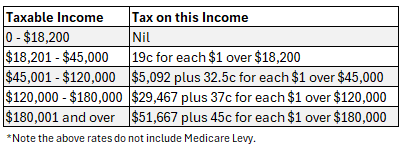
The current tax rates (to 30 June 2024) are as follows:


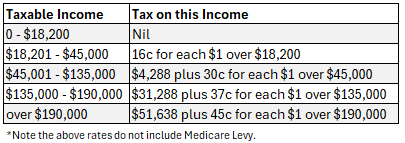
From 1 July 2024, the reduced tax rates are as follows:


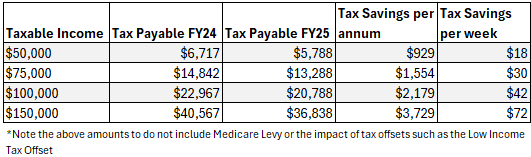
The tax savings for certain income levels are as follows:


The last table shows the difference between the tax payable for the 2024 financial year, compared to the tax payable for the 2025 financial year and how much that translates to a weekly saving.

Energy bill relief

A $300 rebate will be applied to all Australian households towards their electricity bills.  This will be a $75 credit on each quarterly electricity bill in the 2024-25 financial year.  Eligible small businesses will receive a credit of $325.

HECS

Another measure that was announced last week was the change to the HECS indexation rate.  Currently, HECS debts are indexed each year on 1 June using the Consumer Price Index (CPI).  Given the high rates of inflation, this resulted in an indexation rate of 7.1% applied to HECS debts on 1 June 2023.

The Budget announcement is to use the lower of CPI and Wage Price Index (WPI) to index HECS debts (backdated to 1 June 2023).  This means that the 7.1% CPI indexation rate used last year will be replaced with a 3.2% WPI (and a credit applied to HECS accounts to reflect the lower indexation at 1 June 2023).

It is also forecasted for the WPI to be 4% for the 1 June 2024 indexation.

Please read our article for more information about the indexation of HECS debts and whether it is beneficial to repay some or all of your debt.

Medicare Levy Low-Income Thresholds

The Medicare Levy low-income thresholds for singles, families, seniors and pensioners will also be increased from 1 July 2023.  The family income threshold will also now be increased by $4,027 per child (up from $3,760).

Rent Assistance

The Commonwealth Rent Assistance maximum rates have been increased by 10% from 20 September 2024 to address rental affordability challenges.

Paid Parental Leave

$1.1 billion was allocated in the budget towards paying superannuation on Commonwealth Funded Paid Parental Leave for births and adoptions on or after 1 July 2025.

Impact for businesses

The Budget contained a few measures to help small businesses:

Instant asset write-off threshold extended

From 1 July 2023, the instant asset write-off threshold was due to reduce to $1,000.  Last budget, this threshold was increased to $20,000 for businesses with an aggregated turnover of less than $10 million.  The increased threshold was to apply until 30 June 2024.  The announcement in this budget was to extend the $20,000 threshold to 30 June 2025.  We note that the announcement from last year’s budget (to increase the threshold to the $20,000) has still not passed by Parliament, leaving this measure uncertain as we close in on the end of the financial year.

We also note that, assets acquired for more than $20,000 can continue to be placed into the small business simplified depreciation pool and depreciated at 15% in the first year and 30% thereafter.

ATO Counter-Fraud Strategy

$187 million has been allocated to the ATO Counter Fraud Strategy, including allocating funds to:

  • Identify and block suspicious activity in real time
  • Recover lost revenue from fraud
  • Counter fraud
  • Extend the period for which the ATO can withhold GST refunds (extended from 14 days to 30 days)

ATO Tax Avoidance Taskforce

The ATO Tax Avoidance Taskforce has been extended for 2 years from 1 July 2026.  The task force pursues key tax avoidance risks from multinationals, large public and private businesses and high-wealth individuals.

Foreign Resident CGT regime

The foreign resident capital gains tax (CGT) regime will be strengthened to provide greater certainty about the operation of the rules.  The amendments will apply to CGT events on or after 1 July 2025 and will:

  • Clarify and broaden the types of assets that foreign residents are subject to CGT on
  • Amend the point-in-time principal asset test to a 365-day testing period
  • Require foreign residents disposing of shares and other membership interests exceeding $20 million to notify the ATO, prior to the transaction being executed

Supporting Small Businesses

$41.7 million has been specifically allocated to supporting small businesses, as follows:

  • $25.3 million to support the Payment Times Reporting Regulator;
  • $10.8 million to extend the Small Business Debt Helpline;
  • $3 million to implement the Government’s response to the Review of the Franchising Code of Conduct;
  • $2.6 million for the Australian Small Business and Family Enterprise Ombudsman to support unrepresented small businesses to navigate business-to-business disputes through alternative dispute resolution.

We will keep you up-to-date with the progress of the implementation of these Budget measures.

If you would like to discuss the tax implications of the budget proposals, please call us on (07) 56656469.

DISCLAIMER: The information in this article is general in nature and is not a substitute for professional advice. Accordingly, neither TJN Accountants nor any member or employee of TJN Accountants accepts any responsibility for any loss, however caused, as a result of reliance on this general information. We recommend that our formal advice be sought before acting in any of the areas. The article is issued as a helpful guide to clients and for their private information. Therefore it should be regarded as confidential and not be made available to any person without our consent.

Federal Budget 2023-24

On Tuesday night, 9 May 2023, Federal Treasurer Jim Chalmers handed down his second Federal Budget for the Labor Government.  According to the Budget papers, the Budget has returned “into the black”, delivering a surplus for the first time in 15 years.  Our country’s financial position has benefited from high commodity prices and a stronger than expected jobs market.  Similar to last year, the Treasurer has cast the Budget with aims to provide cost of living relief whilst not placing additional pressure on inflation.

Some wins from the Budget will be for those eligible for the Government’s energy relief package.  High income earners are also winners with no mention of changing or removing the stage 3 income tax cuts legislated to come into effect on 1 July 2024.

Those not so happy with the budget will be middle income earners who lost the low and middle income tax offset (LMITO) in the October 2022 budget and who are ineligible to share in most of the incentive packages announced in this budget.

The Treasurer warned of more “difficult decisions” to come.  Hopefully those difficult decisions are answered from a position of fiscal responsibility and not just a politically motivated standpoint.  Difficult decisions do need to be made around a well-rounded, broad tax revenue base in years to come.

We’ve outlined below some of the measures that were announced in the Budget that will impact on our clients.  As with all budgetary measures, these measures are not final until the relevant legislation has been passed by the Government.  We will keep you updated on the status of any proposed measures.

Income tax measures

The previously legislated stage 3 tax cuts for individuals starting 1 July 2024 remain untouched.

There was no extension announced to the low and middle income tax offset (LMITO) beyond the 2021-22 year.  As such, the LMITO has now ceased.  Consequently, low-to-middle income earnigns (incomes up to $90,000 but phasing out up to $126,000) will see their refunds reduced between $675 and $1,500 from the 2023 year onwards.

The Medicare Levy low-income thresholds will marginally increase from 1 July 2022 (which increases the point from which the Medicare Levy will start to apply). 

Business measures

The Budget contained a few measures to help small businesses:

Instant asset write-off threshold increased to $20,000

From 1 July 2023, the instant asset write-off threshold was due to reduce to $1,000.  This budget measure has increased this threshold to $20,000 for businesses with an aggregated turnover of less than $10 million.  The increased threshold will apply until 30 June 2024.

Assets acquired for more than $20,000 can continue to be placed into the small business simplified depreciation pool and depreciated at 15% in the first year and 30% thereafter.

Small Business Energy Incentive

Small businesses with a turnover of less than $50 million can deduct an additional 20% of the cost of eligible depreciating assets that promote greater energy efficiency.

A range of depreciating assets will be eligible for the incentive (including energy efficient fridges, heat pumps and electric heating or cooling systems, batteries and thermal energy stores).  The assets will need to be first used (or installed ready for use) between 1 July 2023 and 30 June 2024.

Up to $100,000 of total expenditure will be eligible for the incentive (which will provide a maximum bonus deduction of $20,000).

Energy Price Relief Plan

Small businesses customers of electricity retailers will benefit from $1.5 billion in funding that the Government has committed to provide energy bill relief.

Payday Super

From 1 July 2026 employers will be required to pay their employees’ super guarantee at the same time as their salary and wages.

Help to manage tax instalments

The GDP adjustment factor for PAYG tax instalments and GST instalments will be 6% for the 2023-24 financial year (down from 12% under the statutory formula).

Startup support

$431.9 million is being provided over 4 years to support small and medium businesses and startups to commercialise their ideas and grow their operations.  This funding will be targeted at businesses operating in the priority areas of the National Reconstruction Fund.

Register of beneficial ownership

$1.9 million provided to establish a public register of beneficial ownership of companies and other legal vehicles (including trusts).

Expanded ATO Compliance Programs

Funding is being provided to extend several ATO compliance programs. 

Personal Income Tax Compliance Program

$90.2 million will be provided to the ATO and Treasury to extend the Personal Income Tax Compliance Program for 2 years from 1 July 2025 and to expand the scope from 1 July 2023.  This enables the ATO to continue to deliver a combination of proactive, preventative and corrective activities in key areas of non-compliance, including over-claiming of deductions and incorrect reporting of income. 

GST compliance

$588.8 million will be provided to the ATO from 1 July 2023 for the ATO to continue a range of activities that promote GST compliance. 

Debt collection

Additional funding will be provided to the ATO to facilitate engagement with taxpayers who have high-value debts over $100,000 and aged debt older than 2 years.

Lodgement penalty amnesty

Small businesses with an aggregated turnover of less than $10 million will have failure to lodge penalties remitted for outstanding tax statements lodged between 1 June 2023 and 31 December 2023 (where those statements were originally due between 1 December 2019 and 29 February 2022).  This is designed to encourage small business owners to re-engage with the tax system.

Superannuation guarantee compliance

$40.2 million provided to the ATO in the 2023-24 year to assist with enforcing superannuation guarantee compliance.  The ATO will continue to use data matching to identify superannuation guarantee underpayment.

Superannuation

Tax changes for super account balances above $3 million

The Government confirmed their commitment to increasing the tax rate for earnings on superannuation accounts in excess of $3 million from 1 July 2025.  Earnings that correspond to the proportion of an individual’s superannuation balance over $3 million will be taxed at 30%.  Earnings that relate to assets below the $3 million threshold will continue to be taxed at 15% (or 0% if held in a retirement pension account).

Other measures of interest

Some other measures of interest include:

  • Increase to certain government payments
    • The base rate of the working age and student payments will increase by $40 per fortnight from 20 September 2023 (this applies to JobSeeker, Youth Allowance, Parenting Payment, Austudy, ABSTUDY, Disability support pension, special benefit).
    • The maximum rates of Commonwealth Rent Assistance allowance will increase by 15%.
    • Parenting Payment (single) will be extended to single principal carers with a young child under 14 years of age (currently, the payment only supports single principal carers with a child under 8 years of age).
  • Household Energy Upgrades
    • $1.3 billion in funding is being provided to establish the Household Energy Upgrades Fund which will provide low-cost finance and mortgages (in partnership with private institutions) for home upgrades to save energy.
  • Childcare
    • $72.4 million in funding over 5 years to support the Early Childhood Education and Care sector to build and retain their workforce.
  • Aged Care
    • From 30 June 2023, there will be a 15% increase to the award wages for many aged care workers. 
    • Over $1.1 billion provided to improve the in-home aged care system and the delivery of aged care services.

We will keep you up-to-date with the progress of the implementation of these Budget measures.

If you would like to discuss the tax implications of the budget proposals, please call us on (07) 56656469.

DISCLAIMER: The information in this article is general in nature and is not a substitute for professional advice. Accordingly, neither TJN Accountants nor any member or employee of TJN Accountants accepts any responsibility for any loss, however caused, as a result of reliance on this general information. We recommend that our formal advice be sought before acting in any of the areas. The article is issued as a helpful guide to clients and for their private information. Therefore it should be regarded as confidential and not be made available to any person without our consent.